Posts

Generosity is happiness

Image
assessment: how does generosity make us feel? When asked what they know about generosity the children talked about kindness, helping others and being nice. What does it mean to be nice and how can we be kind and helpful to others?  We read the story 3 Kind Mice by: V. Schre as our feature story for the word "kindness".  The children thought it would be a lot of fun to have a party just like in the story so together we made invitations and planned for cake and treats for our Generosity party.   The story behind the Generosity party They were so excited about inviting the other children to a party they planned themselves.  We made a yummy chocolate cake to share and goody bags to give the children at the end of the day.  The children in the Earth group noticed the gleaming faces of the children as we ate and laughed together.  Allye is mixing the batter Damon is mixing the butter and the sugar Matthew: We are having a generosity par...

Friday Art: Learning about lines

Image
A line is anything in an artwork in the distance between 2 points What is a line?  For the next 3 Friday Art days the children will be exploring LINES as an art element.  We will be using different tools, play games to create and explore different kinds of lines.   In this particular grouptime the children learned about lines which show direction: vertical, horizontal, diagonal, zigzag and curvy.  First, we looked around the room to find these lines and we discovered that they are everywhere; there are even lines on our bodies! We practiced writing/drawing these lines in the air and on paper using markers.  We even drew lines with our heads, our tongues and our bottoms.  How does it feel like to move through these lines? We played a song game called "We are going walking" where children walked on either a zig-zag or straight line and at the end they were to stop and do a yoga pose. They enjoyed this game so much and invited the chi...

Leaf Man: Colours in Nature continued....

Image
"This is a bat with a fly and it's raining" We continue to explore colours in nature by learning about children's authors and illustrators using colours if nature as their inspiration in creating wonderful stories.  In this grouptime we looked at Lois Ehlert, who is known for her unique and style called "Found Art"where she incorporates items found in nature or at home to create colourful and vivid illustrations.  The book "Leaf Man" is a great story to encourage storytelling creativity and imagination.  After reading the children ventured out into the forest to collect leaves, twigs and pine cones to create their very own Leaf Man creature.   The children really enjoyed making the Leaf Man because this activity allowed them to move their items freely until they were satisfied with their creation.    gathering leaves in the forest While gathering the leaves in the forest Matthew made a comment about the brown leaves.  First I ask...

Colours in Nature

Image
Practicing the blow paitning water colour painting the sky tree scene Allye: Mine is a winter sky tree Lately the children have noticed how some of the leaves are falling or changing colours.  They've observed that as it gets colder the trees and the forest is changing too. We started talking about the different seasons and how we can predict the changes in seasons by looking at the changing colours of our outdoor nature. Seeing colours in Nature We read the book "Sky Tree" by Locker and carefully noticed the different colours the illustrator used to represent the different seasons.  The book also shows how colours blend together to show the relationship between the sky colours and the tree as it cycles through the different seasons.

Value of colour: shade and Tint

Image
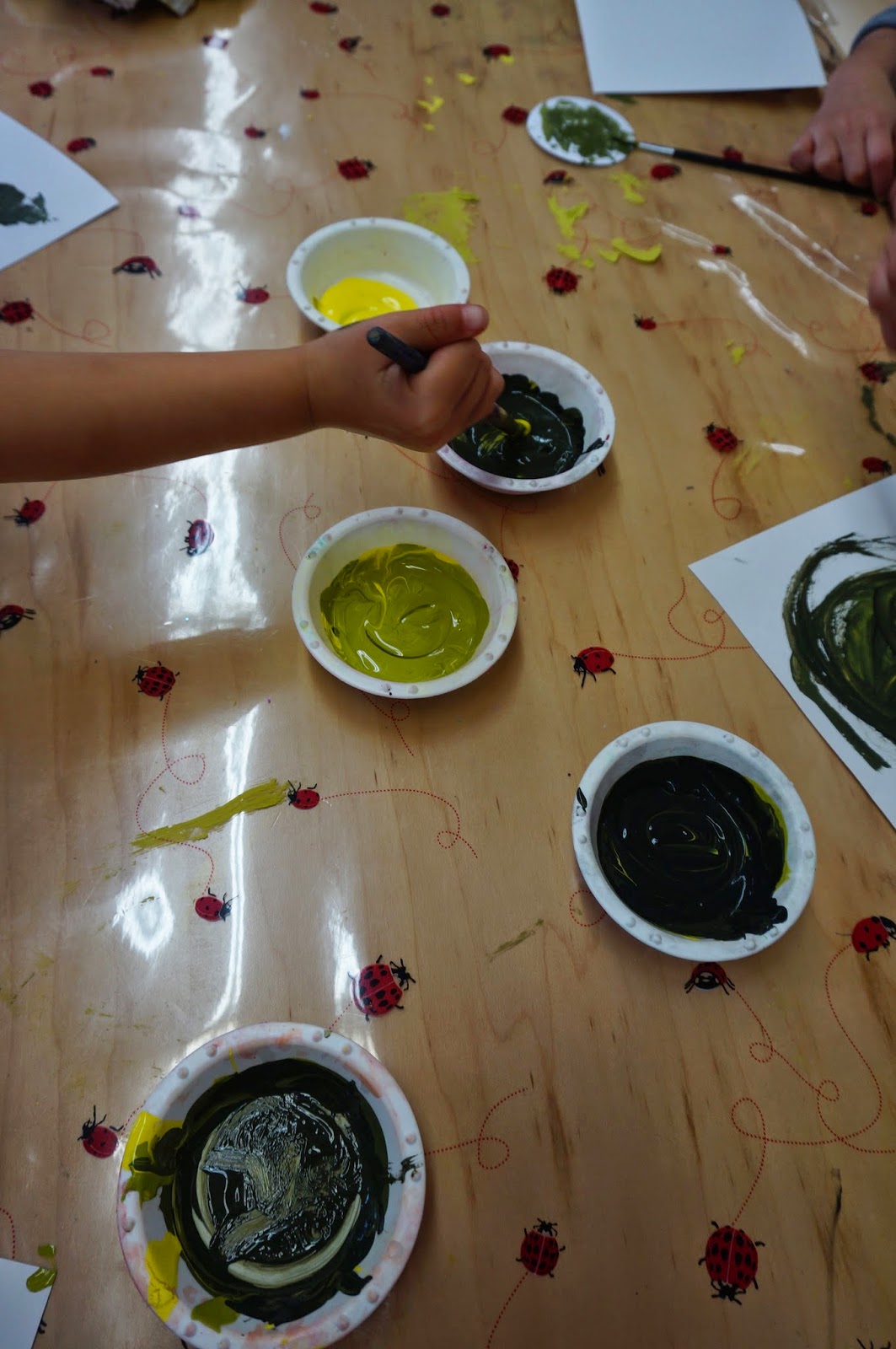
Shade: when black is added to the colour TInt: when white is added to the colour monochromatic painting Last week we began looking at Value of colour: it is when colour becomes lighter or darker.  The children asked: how can we make colour darker or lighter?  We first experimented with adding white and black to the colours to see what will happen.  The children predicted that black might make the colour darker and white will turn the colour lighter.  After playing around with mixing various colours the children got to paint with the mixed colours and chose how much more or less of white and black to use.  They noticed that as they add more or less the value of the colour also changes.   Julia discovered a tint of red: pink  Last Friday the children made monochromatic paintings to see the contrast between the original colours and the tint/shade mix.   Pink!!! Allye: Mine is lip balm pink Nico: Mine is a flower...

Mouse Paint: an assessment tool

Image
To review our Secondary Colours we read the book Mouse Paint and created our own mouse paint illustrations using hand prints. The children were asked to pick a secondary colours they want their mouse to be. Then, they were asked to show which 2 primary colours they need to mix to get that secondary colour they want. As we were painting the children noticed how the colour purple became darker when we added more blue and brighter when we added more red. Matthew suggested that the orange looked more red maybe because there was more red in the mixture.  I think these observations are a great way to start our discussion on tint and shade of colours. After the paint dried I helped the children add the eyes, ears, tail, and whiskers of their mice. Elaine made orange by mixing yellow and red "My purple is dark" Matthew didn't want to show his face "I just made purple!"

Secondary colours

Image
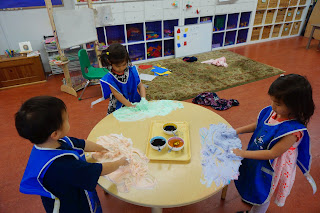
coloured shaving cream experiment In this grouptime we addressed the children's questions on mixing colours: Nico: "How do you get green?" Damon: I got orange. I don't know how... "I mixed red and blue to get purple" We began by recalling the primary colours and then we made a prediction chart to show what might happen if we mix 2 primary colours.  For fun we used shaving cream and added food colouring to see what colours we get when mixing the primary colours. We found that we can make Secondary colours by mixing 2 Primary colours. Yellow + Red = Orange Red + Blue = Purple Yellow + Blue = Green Nico was double checking our predictions