Posts

fairy magic spells

Image
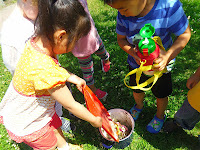
Judy adding ingredients to our magic potion Pointing at where "diwata" fairies might exist Francine placing a sticker to mark the map   What are faires?    Are fairies real or are they just found    mixing & chanting                                                         Bela's turn to mix       in stories? turn you into a rock! The children have plenty to say about fairies. They think fairies are definitely real and are "magical teeny-tiny things who look like people but with wings and live in an enchanted forest and turn other things into something else" a definition composed by Judy, Aston, Lucas and Simon.  The children's description of fairies are sort of limited to what they might see on tv and the typical fairytale stories so to broaden their ideas we looked...
What is a plant?

Image
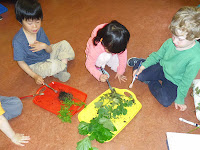
        Investigating plants   Lucas: Why do we have to learn about living things and plants? Isaak: How do plants grow? What do they need?  We collected plants from our forest and investigated their parts and compared the different features. They were curious about how each part works and helps the plant grow.  Isaak predicted that the "stems have have straws which drink the water all the way up".  To check this theory we sliced open some stems and discovered that they were actually hollow inside. He then changed his idea and concluded that the whole stem in like a straw and that the fibers (I supplied him the term) is what makes the stem work.  We also did a few experiments on absorption to investigate how root systems suck the water from the ground. During our walk in the forest, they observed that tree roots can absorb more water since they have much larger roots and they also began to wonder why trees are also plants a...

Plants in our Midst (Formative Assessment)

Image
 We are now starting a new unit on plants. This week the children began to gather ideas and questions about how plants grow, what they need, and how they help us. Below are the concepts and teacher questions which will guide our thinking throughout this unit. Key concepts Form Function    Responsibility What teacher questions/provocations will drive these inquiries? How are plants in our local area similar and different? How do animals/people use plants? Is it important for us to take care of plants? We started with understanding the differences between living & non-living things. We used the following criteria to sort out various objects from living to non-living things. Living things are things that: move, breathe, take space, grow, need food and water and reproduce. We also went for a walk in the St. George's trail on the Southwest Marine side to observe different features of plants and notice living and non-livi...

From Farm to Fork

Image
How is our food is harvested and delivered to our dining table? The children in the Earth group wondered where bakery shops and grocery stores get their food supplies.  Simone said: "Maybe the baker gets it from Cosco".  Where do stores like Cosco get their stuff? I asked. So we inquired further and watched a video to see how it all works.  They were amazed by the machinery  in the processing plant and the jobs that people do.  The video was very helpful in understanding how the different community groups are interconnected and involved in the process of harvesting, distributing, selling and consumption of food supplies. After we  created a diagram and a diorama to show what we learned. The photos below also show us sorting and learning about various fruits and vegetables.  When we played the song game Oats and Beans and Barley grow the children were not sure what the word "crops" mean so we played this sorting game to help us know and identify ...

Responsibilites

Image
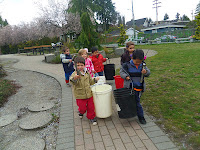
This week the children explored the concepts of FUNCTION and RESPONSIBILITY.  We all have different roles we play in the various communities.  For example at our centre the children felt that  cleanliness and organization are important so we used our service learning chart to help us check what our cleaning responsibilities are and practiced it throughout the week.  Then we went outside to pick up garbage around the playground to show that our responsibilities are not just limited in one space but to every community we are part of.   We also discussed that in part people perform and continue to stay  committed to their responsibilities because we CARE for one another and our community.   
Image
"I want to be a cake maker when I grow up!" Nicky excitedly expressed to the group.  This led to our exploration of the Baker and other community members who are essential in maintaining the bakery shop like the farmer, miller, truck driver, grocer, and the truck mechanic. We worked on a map to demonstrate the CONNECTION of each community member and how they work together.  We've also discovered that a failure of one helper can disrupt the whole community.  For instance if the delivery truck breaks down then supplies won't be delivered and the baker can't make some of the goodies.  A concerned Isaak said: "Oh no! The bakeshop will close down!" Another idea they have is a baking party which is a great way to practice cooperation and caring behaviour. Olivia called us the baking community; they brought in some baking supplies and took turns mixing the ingredients.  We observed how we each contributed to the baking task as we worked together like a team....
Image
Based from our walk along the Dunbar neighbourhood and our class discussion the children defined community as a group of people who work together. We created a poster to show their understanding of the different types of communities they are part of such as the home, school and other groups they participate in.  They realize that they each have different roles in each of those groups and that cooperation is key in supporting the development of a strong community.  For example one of the "jobs" they feel is important in our daycare is cleaning and organizing toys.  They worked together in sorting out blocks, toys and sprayed tables.   All of these is good in theory but what does it look like in practice?  So they went and told the other children about their experience and invited them to do the same.