Posts

Responsibilites

Image
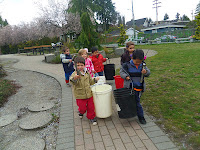
This week the children explored the concepts of FUNCTION and RESPONSIBILITY.  We all have different roles we play in the various communities.  For example at our centre the children felt that  cleanliness and organization are important so we used our service learning chart to help us check what our cleaning responsibilities are and practiced it throughout the week.  Then we went outside to pick up garbage around the playground to show that our responsibilities are not just limited in one space but to every community we are part of.   We also discussed that in part people perform and continue to stay  committed to their responsibilities because we CARE for one another and our community.   
Image
"I want to be a cake maker when I grow up!" Nicky excitedly expressed to the group.  This led to our exploration of the Baker and other community members who are essential in maintaining the bakery shop like the farmer, miller, truck driver, grocer, and the truck mechanic. We worked on a map to demonstrate the CONNECTION of each community member and how they work together.  We've also discovered that a failure of one helper can disrupt the whole community.  For instance if the delivery truck breaks down then supplies won't be delivered and the baker can't make some of the goodies.  A concerned Isaak said: "Oh no! The bakeshop will close down!" Another idea they have is a baking party which is a great way to practice cooperation and caring behaviour. Olivia called us the baking community; they brought in some baking supplies and took turns mixing the ingredients.  We observed how we each contributed to the baking task as we worked together like a team....
Image
Based from our walk along the Dunbar neighbourhood and our class discussion the children defined community as a group of people who work together. We created a poster to show their understanding of the different types of communities they are part of such as the home, school and other groups they participate in.  They realize that they each have different roles in each of those groups and that cooperation is key in supporting the development of a strong community.  For example one of the "jobs" they feel is important in our daycare is cleaning and organizing toys.  They worked together in sorting out blocks, toys and sprayed tables.   All of these is good in theory but what does it look like in practice?  So they went and told the other children about their experience and invited them to do the same.

Snail Mail vs Email

Image
These days people keep in touch with one another through emails, chat lines and other forms of social media.  A long time ago the only way was to send letters by post. The children wrote letters and dropped them off to the nearest mailbox.  They were excited about the walk and predicted how many sleeps it would take till their letters arrived.  We also sent emails to our families and they figured it would be a whole lot faster than sending letters by post.  We constructed our own mail box and we'll be "mailing" letters to one another as each of the children take turns be the mail carrier of the day.

Working together

Image
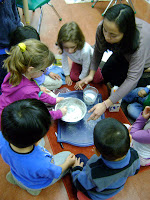
We learned that in the Pioneer days the children did a lot of work at home and it was expected of them to do chores to help the family.  Safety rules have also changed overtime on what children are allowed and not allowed to do by themselves. In our discussion they pointed out that although we don't do the same chores or have the same rules like in the pioneer days we still help our parents because it's important to work together as a family.  We enjoyed taking turns making buckwheat pancakes, whipped butter, oatmeal and washed our dishes after the feast was done.  We had so much fun didn't seem like work at all!

The Pioneer Times

Image
Today we began our exploration of then and now. The children were particularly curious about how it was like at home in the olden days cooking, grooming and the toys children. To get a sense of how different life was back then we watched a video about the Pioneers in Canada. They were amazed by the chores and activities children can do in the olden days. Aston noticed that "they did a lot of work but it might be fun" he thought . Using a Venn diagram we compared our daily activities to that of the Pioneers. The main difference was that people made and collected their own supplies whereas these days we buy most of our things. Children back then were involved in the family livelihood; they were independent and free. Some things have stayed the same. Simone pointed out that like in the olden days families help each other. In the next few days we'll act, dress-up and live like the Pioneers. We'll make our food from scratch and build things using tools from the olden...

Decorating our bodies

Image
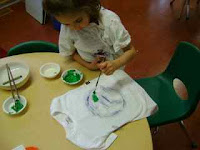
Just like our surroundings people decorate their bodies with colourful clothing and accessories to make themselves beautiful and presentable. We looked at photographs of different cultural groups showing variety of ways people use headdresses, hats, necklaces and clothes to represent who they are and where they are from. The children made the connection between clothing and group identity. We thought of team jerseys and uniforms and as one child pointed out "it helps us sort out the people in their groups". The children were also intrigued with costumes and shirt logos so together we designed a t-shirt to represent the Earth group. Together they decided that a picture of the Earth will best describe their team.