Posts

Tint & Shade

Image
Tint is adding white to colours to make it lighter Shade is adding black to make colours darker "The yellow disappears! It's lighter" "Hey I made beige! mixing colours is fun "This looks like the forest" Earlier on in the unit the children suggested that colours can be light or dark but they don't know how that happens.  In these activities the children explored Tint and Shade by mixing colours.  Tint is done by adding some white to the colour making it appear lighter where as shade is when we add black to the colour making it appear darker. As we experimented with our colours the children discovered other colours they knew about like Beige, Navy Blue, Sky Blue, Pink,a and Gray.  They also were interested in naming their own colour or asked me to give them the "proper" name for it like Maroon, Olive green and Tan. We are going to apply what we learned about Tint and Shade to our summative assessment project which ...

Plant dye

Image
Preparing for plant dying experiment Jeffrey's carrot juice spit. investigating the veggies/fruits Dying yarn with natural food dye  Extracted vegetable dye The children wondered about how the colours get into our clothes.  Orin said we buy clothes at the store and they colour it there. I shared my experience with plant dye when I went on a hiking trip in Peru.  There I saw and experienced how the locals would use natural plants and even dried insects to dye fabric.  I showed them pictures of my trip and they were amazed by the colourful fabric and most of all the llamas and alpacas where they get they get their wool.  We also watched a video from National Geographic to show how this process of dying is done in that region. It would have been fun to gather wild plants from our forest like Oregon grapes and but I was told we are not actually allowed to do that.  So I went to the store and got a few vegetables and fruits to...

People use colour to decorate their clothes and bodies

Image
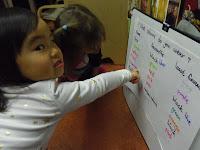
In this grouptime acitivity our focus was to investigate how we use colours in our clothing and bodies. We played a song game "Mary Wore Her Red Dress" and here the children got to show off an article of clothing they are wearing and talk about the colour.  As we played the game I  noticed how the children would choose a part of their clothing which has their favourite colour. We made a chart to show which colours are their favourite and which ones are the least favourite. The children noticed that some share similar colours they like.   Francine pointing her favourite colour Pippa showing off her pink shoes Jeffrey loves green 

Colours and feelings

Image
matching feelings with colours black makes me feel scared Colours can make us feel a certain way. Sometimes people use colour to describe how they feel. In these activities the children thoughtfully expressed how colours can affect or be used to describe their emotions. We did a matching game where the children identified the facial expression on the photo and then matched it with the colour, which to them best represents that feeling. We discovered that we each have  different perspectives on how colours can make us feel.  Orin: purple makes me feel silly and orange makes me happy Tai: green makes me happy Pippa: black makes me scared and red makes me happy Francine: white makes me feel sad Luka: yellow makes me happy and red makes me sad. We read the story, "My Many Coloured Days", a Dr Seuss story. This story describes how we encounter all sorts of feelings all the time. The book was helpful in creatively showing imaginative illustrations to explore fee...

Green, Orange, Purple are Secondary Colours

Image
Working on the colour equation.  "Hey, I made green! I mixed blue and yellow."  getting ready to colour our plain playdough Pauline adding blue and red colour to make purple Our focus in these activities is to understand that Secondary colours are two primary colours mixed together.  Using scarves and our bodies we pretended we were the colour ingredients mixing and predicted what colour we can make.  They loved this game because it involved a lot of moving and shaking around. One of them said we are "cooking the colours". Too bad I couldn't capture a photo of this moment since I was shaking along with the children.  Again, we watched the Mouse Paint video to include those children who were not present the day before  and to review Secondary colours.  I provided two experiences where the children can independently manipulate the colours and discover the secondary colours on their own.  First, using play dough: they each ch...

We can change colours by mixing

Image
mixing food colouring using droppers Alan watches the colour bubbles gradually mix looking through coloured cellophane "Look, I made green!"- Alexis "I'm mixing all the colours."- Tai How can we change colours? To answer this question we did an experiment using food colouring and  coloured cellophane.  I let the children play, explore freely and predict what might happen to the  Yellow, Red, and Blue (Primary) colours.  They discovered that MIXING and COMBINING can  change colours.  We watched a video called Mouse Paint (also a book by Ellen Stoll Walsh) where 3 mice discovers other colours by mixing the primary colours.  As they watched Orin said: "we were mixing colours too like the mice, it's so much fun!" I pointed out how important the primary colours are in making other colours and the children described to me what colours they can mix to make green, orange, and purple. As I was sending them over for lunch I h...

New unit: Colour our World

Image
Welcome to our new unit on Colour! The following are the concepts and lines of inquiry which will guide us in our conversations and activities with the children: Function- People use colour to communicate with one another and to decorate themselves and their homes. Perspective- Colours can sometimes make us feel a certain way Change- mixing can change colours. With their eyes closed I asked them to share what they see and feel...if they see any colour. Some said it's too dark, they see black and it feels scary because it reminds them of Halloween. We then opened our eyes and  started by noticing our classroom, where they can find colour and how it feels to be surrounded by an array of colours. Lysander commenting on a photo "I made a rainbow" Using photos we began discussing how people use colour. At first they weren't sure how to respond to my question so I asked each one to pick a photo to talk about and describe how colour is used. Their comme...